






Hydraulic Cylinder Force & Speed Calculations
When you’re working through a hydraulic cylinder calculation, there’s no room for guesswork. Whether you’re checking system loads, picking cylinder specs or troubleshooting, you need to understand how force and speed are produced and what affects them.
It all comes down to a few key formulas with the right inputs – fluid pressure, bore diameter, rod diameter, and flow rate.
Understanding Hydraulic Pressure and Cylinder Output Force
Every hydraulic cylinder works by using pressurised fluid to produce force. This output force depends on how much pressure is applied and over what surface area. That area comes from the piston diameter, or more precisely, the effective area of the piston.
Hydraulic pressure is usually measured in bar or psi. This pressure acts on the piston face to produce linear motion. Depending on whether you’re working on the bore side (extend) or the rod end (retract), the available surface area changes which affects force.
Formula:
Force (N) = Pressure (bar) × Piston Area (cm²) × 10
If you’re working in PSI:
Force (lbs) = Pressure (psi) × Piston Area (in²)
Why multiply by 10? Because 1 bar equals 10 N/cm².
Calculate Piston Area Using Cylinder Diameter
To get the piston area, you use the area of a circle:
Area = π × (Bore Diameter ÷ 2)²
Let’s say you’ve got a diameter cylinder with a 100 mm bore. You’d do:
Area = π × (100 ÷ 2)² = 7,854 mm² = 78.54 cm²
That’s your full piston area. When retracting you subtract the rod area:
Rod Area = π × (Rod Diameter ÷ 2)²
If the rod diameter is 50 mm the area is 19.63 cm².
So, retraction surface = 78.54 – 19.63 = 58.91 cm²
Cylinder Force Calculations for Push and Pull
Using the areas above, you can now calculate the force.
Extend Force:
= Pressure × Full Piston Area × 10
= 150 bar × 78.54 cm² × 10 = 117,810 N (118 kN)
Retract Force:
= Pressure × Reduced Area × 10
= 150 bar × 58.91 cm² × 10 = 88,365 N (88.4 kN)
These are the theoretical figures, the actual force may be lower due to internal losses. Always check component efficiency or compare with a hydraulic cylinder calculator to double-check figures.
Speed Calculations Based on Hydraulic Pump Flow
Cylinder speed depends on how fast the hydraulic pump can move fluid into the cylinder. The more flow, the faster the cylinder moves.
Formula:
Speed (mm/s) = (Flow Rate L/min × 1000) ÷ Piston Area (mm²)
So with 25 L/min and a piston area of 7,854 mm²:
Speed = (25 × 1000) ÷ 7,854 = 3.18 mm/s
Want speed in m/min? Multiply by 0.06.
How Fluid Power and Component Sizing Affects Output
Hydraulics is all about fluid power. This means the ability to transfer energy using fluid pressure. But that energy transfer only works well when your components are matched:
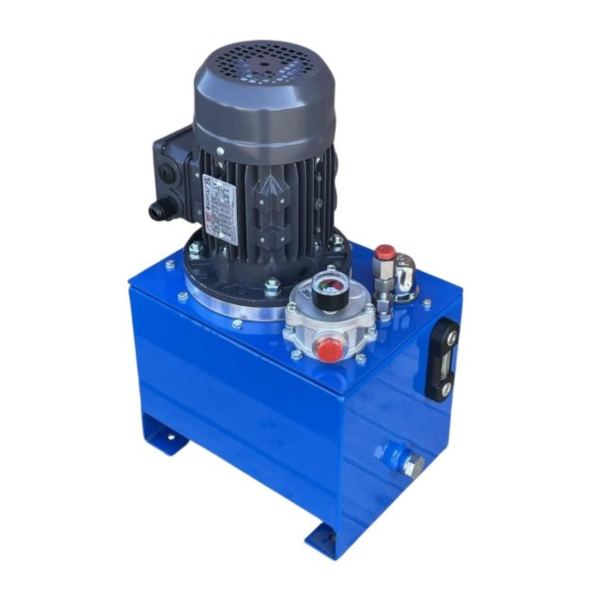
- A small hydraulic power unit won’t supply enough volume for a large bore.
- A high-speed hydraulic pump may overshoot a small-bore cylinder.
- Undersized hoses, poor valve choices or long pipe runs can cause pressure losses.
Always refer to a cylinder calculator or the engineering toolbox when specifying your setup.

Tonnage, PSI, and What Pressure Is Needed To Develop Force
If you want to work out how much tonnage a cylinder can generate:
Tonnage = Force (N) ÷ 9,810
So if your force is 118,000 N, divide by 9,810 = 12 tonnes approx.
If you’re working backwards and want to know what pressure is needed to develop a certain force:
Pressure (bar) = Force ÷ (Area × 10)
This helps with specification. If you’re retrofitting or trying to see if a pump can handle a job, this is where calculations help.
Effective Area, Force Produced and Real World Results
The force it can create on paper might not be what the cylinder can generate in real life. The reasons for this are as follows:
- Seal drag and friction reduce the force
- Oil temperature changes viscosity, affecting how easily it flows
- Valves and pipework create pressure drops
- If the pump is underpowered, actual flow may drop under load
Always allow for 10-15% efficiency loss when comparing theory to practice.
Calculator Tools and Common Hydraulic Cylinder Errors
Online hydraulic cylinder calculators can be helpful for quick estimates but always cross-check with physical specs.
The most common mistakes are:
- Forgetting to subtract rod area on retraction
- Using theoretical pressure without checking relief valve settings
- Ignoring losses from directional control valves
- Mixing up units (cm² vs mm²)
Keep it clean and consistent – always work in the same unit set.
FAQs
Q: Can I use a pneumatic cylinder calculator for hydraulic applications?
No. Pneumatic and hydraulic systems work on different pressure ranges and compressibility factors. Use a calculator made for hydraulic cylinder calculations.
Q: Does rod end size affect pull force?
Yes. A larger rod diameter means less area, which reduces force during retraction.
Q: Can two cylinders with the same bore but different rods have the same force?
Only on extension. Pull force depends on the rod end size.
Q: What’s the link between bore diameter and fluid power?
Larger bore diameter gives more surface area, increasing output force for the same pressure.
If you’re trying to calculate hydraulic cylinder force, check speed or work out pressure requirements. This guide gives you the key formulas, real-world checks and reasons behind the numbers.